Observational workplace commentary
Workplace satire, not workplace complaints
Work is weird.
Make it worth sharing.
Pick a familiar office ritual. MaxEscape turns it into a sharp observation, a visual joke, and a LinkedIn-ready caption that stays conceptual instead of sounding like a public grievance.
No loginNo automatic LinkedIn postingVerified historical quotes are curated locallyImages are generated separately from the caption
Pick the workplace ritual.
The joke works better when the problem is specific. Choose one below or describe your own.
Workplace pattern
The problem
Shareable graphic4:5 LinkedIn format
◌The image will appear here.
meme.maxvfy.com
Work happened.
LinkedIn captionProblem first, observation second
Historical quotations come from a reviewed local library with source information. MaxEscape never asks the AI to invent an attribution.
More than a generator.
The Workplace Library explains the behavior behind the joke and shows how to talk about it publicly without making the post sound personal.
Workplace pattern
Micromanagement
Micromanagement shows up when a task is technically delegated but every small decision still needs observation, approval, or another status check.
Read the pattern → Workplace patternPerfectionism at work
Workplace perfectionism becomes expensive when useful work is finished but tiny, low-impact details keep triggering another round of revision.
Read the pattern → Workplace patternToxic positivity
Toxic positivity at work is not optimism. It is the pressure to sound upbeat when the underlying problem still needs to be named and addressed.
Read the pattern → Workplace patternMeeting overload
Meeting overload happens when coordination takes so much time that the work being coordinated has nowhere left to happen.
Read the pattern → Workplace patternEverything is urgent
Fake urgency appears when ordinary planning failures become last-minute emergencies for everyone downstream.
Read the pattern → Workplace patternScope creep
Scope creep is the slow expansion of a request while the original deadline, budget, and staffing stay exactly where they were.
Read the pattern →Old words. New office.
Short historical quotations can add context and credibility when the connection is real. The source is shown instead of guessed.
“The perfect is the enemy of the good.”
“Striving to better, oft we mar what's well.”
“Well done is better than well said.”
What MaxEscape is trying to do
Make the image carry the joke.
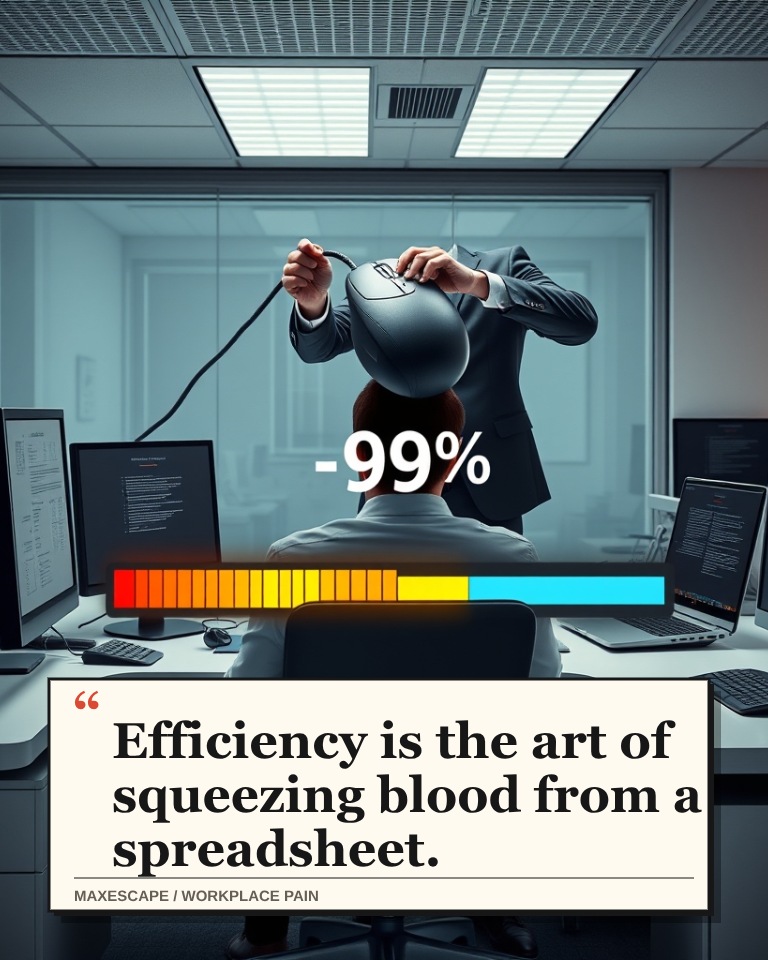
A good workplace meme should still make sense before the caption is opened. The current image direction favors real people, expressive reactions, cinematic office photography, and one absurd physical metaphor — not floating icons, generic dashboards, or vector-style business art.
See curated examples